
The police crashed into a bar. St. Louis taxpayers paid $4.2 million for it.
Filed Friday, October 30, 2026 at 5:33 PM
Twenty-two seconds.
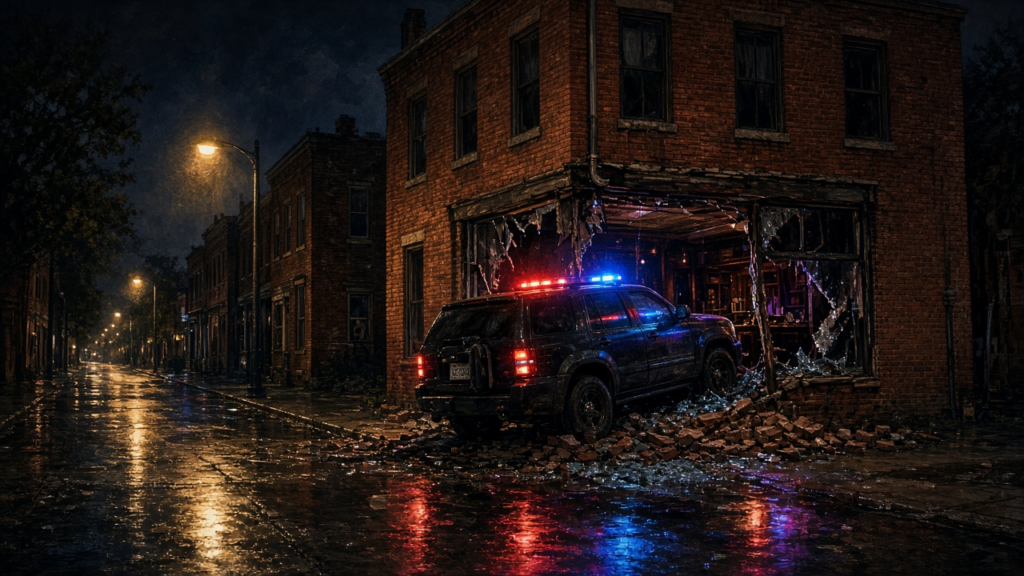
That’s how long it took a St. Louis police officer to put a bar owner in handcuffs on his own sidewalk, minutes after a police SUV had come through the front of his bar.
In the early morning of Dec. 18, 2023, a probationary officer named Zachary Thompson tore through south St. Louis behind the wheel of that SUV. At trial this week, St. Louis Magazine reported, he agreed that he had run red lights and driven well over the limit, as fast as 65 mph on Germania Street, before he crashed into Bar:PM on South Broadway in Carondelet. He also admitted, according to the magazine, that he lied on video that night, blaming the wreck on a dog that never existed. Nobody gave him a toxicology test.
Co-owners James Pence and Chad Morris, who are married, live upstairs. Pence came down first. Then-Officer Ramelle Wallace showed up, cigar in his mouth, and asked for ID. Pence, standing on a public sidewalk, refused and raised his voice. On his body camera, Wallace can be heard telling Pence, “You’re not going to act a fool,” as he cuffs him. Pence was never charged with a crime.
Morris went to find out why his husband was in handcuffs. He says Wallace beat him. He was arrested, jailed and charged with felony assault on an officer and resisting arrest. Those charges hung over him for 22 months, KSDK reported, until Circuit Judge Rochelle Woodiest threw out the case on Oct. 31, 2025, after prosecutors and police repeatedly failed to hand over evidence, including texts from the officers who responded that night.
On Wednesday, with the civil trial underway, the city agreed to pay $4.2 million to settle the lawsuits from both men. The money comes in installments: $1 million within 30 days, $1 million a year for three years, then a final $200,000 in fiscal 2030. St. Louis will be paying for that night for years.
What changed? Wallace testified. On the stand Tuesday, he insisted he isn’t the kind of officer who assaults people without a reason. That opened the door to his record. According to St. Louis Magazine, jurors watched video of Wallace throwing the first punch in a 2023 fight with a detainee at the city jail. They saw an Internal Affairs finding that he used excessive force on a 17-year-old and made false statements about it, the same month as the crash. “Every single other officer who testified in this case said that … Wallace was wrong,” Pence’s attorney, Javad Khazaeli, told reporters afterward.
Let me be clear: most St. Louis officers would never do what Wallace did. But a department that kept him on the street through complaint after complaint has a discipline problem. And somebody has to pay for it.
That somebody is you.
Bar:PM is not an outlier. In September, the Post-Dispatch reported, a judge approved a $1.69 million settlement with the family of Cortez Bufford, who was shot and killed by a St. Louis officer in 2019. In March, a jury awarded $37 million to Tyron Edwards, shot in the back by police at 14 in Walnut Park. On the last day of that trial, the city’s final offer was $1.5 million. Mansur Ball-Bey’s family won $18.75 million from a jury in 2025 over his 2015 killing. A judge later cut that to $8.25 million, which is now on appeal. And dozens more police lawsuits are still waiting their turn, St. Louis Magazine has reported.
Outside the courthouse Wednesday, in remarks captured in a St. Louis Magazine video, Khazaeli offered his own tally. By his math, he said, the city has agreed over the last month and a half to pay “over $30 million” for police misconduct. I can’t reproduce that number from the public record. But just the cases above add up to more than $50 million in settlements and verdicts.
Now here’s where the state takeover comes in.
Since March 2025, the St. Louis police have been run by a board appointed by the governor. Under the current arrangement, as the Post-Dispatch and Missouri Lawyers Media have reported, the city still pays for misconduct that happened before the takeover, while lawyers from the Missouri attorney general’s office defend the officers in court. The state sits at the defense table. City taxpayers cover the check.
Khazaeli blamed the slow settlement on that split. With the state running the police, he said, there are “too many cooks in the kitchen.” He told KSDK that the state wanted to settle sooner and the city took longer to catch up. That’s one lawyer’s account. But the Edwards case shows what delay can cost: a $1.5 million offer became a $37 million verdict. And the state wasn’t the one left holding that bill.
It gets worse. In June, the state board gave double-digit raises to police lieutenants and above. The city charter ties fire pay to police pay, so the city had to find about $1.4 million, St. Louis Public Radio reported, to match those raises in the Fire Department. Part of it came from the $1 million the city had set aside in its budget for police lawsuit judgments. The state handed out the raises. Money meant for police lawsuits helped pay for them.
When the city ran the department, voters could at least fire the people in charge of it. Now officers answer to a board that answers to Jefferson City, their lawyers answer to the attorney general, and the bill goes to City Hall. None of the people who decide whether an officer like Wallace stays on the street have to face the voters who pay when he doesn’t.
That’s not accountability. It’s a tab with nobody’s name on it.
The city should demand that the state share the cost of any case its lawyers take to trial. It should stop draining the settlement fund to pay for raises it didn’t choose. And it should publish every police payout as it happens, so taxpayers can do the math themselves.
Twenty-two seconds to cuff an innocent man. Twenty-two months to clear his husband. And years more for St. Louis to finish paying for it.
Labels: Antonio D. French